

Companies are increasingly aware that a sudden contaminated food compensation claim can put their finances and corporate reputation at risk, especially when minors’ health is affected.
Below we provide an update on the increasing number of daily reported cases, average costs of a recall campaign, very frequent labeling errors, and the main differences between defective product and food contamination insurance.
Which products are currently most frequently recalled from the market in Europe?
Currently, the products most frequently recalled from the market globally and in Italy mainly belong to two categories: food products (due to microbiological risks such as listeria and salmonella) and consumer products (appliances, toys, and vehicles, for technical defects or safety risks).
With specific reference to the food processing sector, which foods are most at risk of contamination?
The foods most at risk of contamination are meats, unpasteurized milk and its derivatives, eggs, raw or undercooked fish, and ready-to-eat vegetable products.
As clearly shown in the table below, contamination recalls can result from biological factors (such as bacteria like salmonella and listeria, viruses, and parasites), chemical (substances unintentionally added during production), or physical (fragments of glass, metal, plastic, etc.).
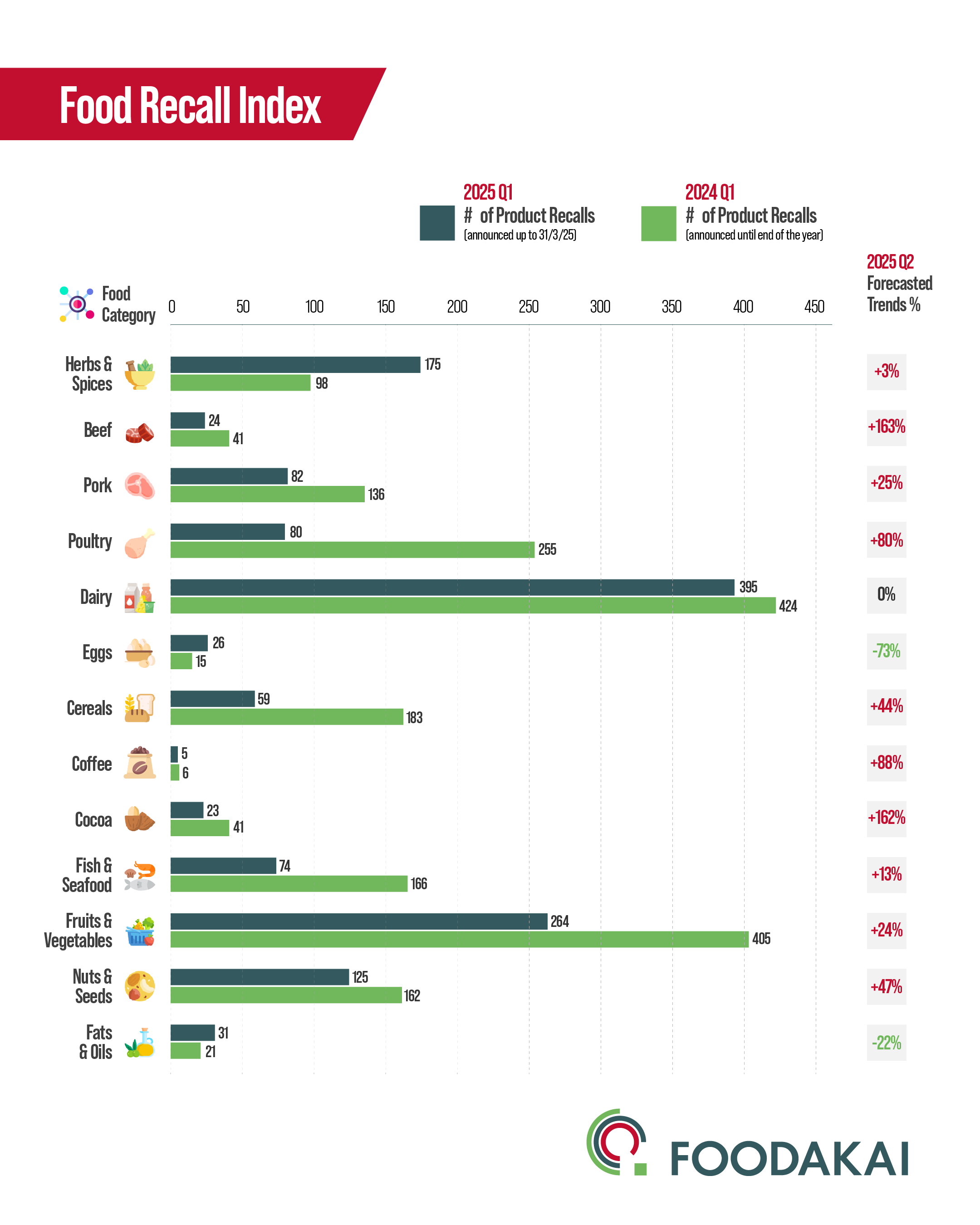
Do food product recall campaigns only affect large companies or medium and small ones as well?
The risk of recall due to contamination or labeling errors affects companies of all sizes.
In January 2025, one of the world’s largest carbonated beverage companies ordered the recall of numerous batches of cans throughout Europe due to the presence of chlorate, a substance derived from chlorine-based disinfectants widely used in food processing and water treatment.
Specifically regarding medium-small companies, in the first half of 2025, EU and UK regulatory authorities reported a total of 2,518 cases of food and beverage recalls, with the total number of product recalls across all sectors set to become the highest in the last ten years.
In October 2025 alone, the EU’s Rapid Alert System for Food and Feed (RASFF) recorded 531 notifications, averaging about 17 alerts per day.
What were the main causes of these recalls?
Chemical contamination remained the main cause of recalls, with aflatoxins as the most frequently cited contaminant, followed by bacterial contamination, with salmonella as the primary agent, mainly in poultry and meat products.
About 60% of October 2025 recalls involved non-EU imports, while the remaining 40% came from within the EU. Turkey and China were the highest-risk countries of origin for alerts, with Poland and the Netherlands recording a high number of alerts within the EU.
Overall, the data for 2025 indicates a high level of vigilance and a complex global supply chain, with persistent issues in managing chemical and microbial contaminants, particularly in imported products.
Is corn a food product less sensitive to food contamination compared to milk and its derivatives: does the risk of contamination still exist?
Product recalls related to tacos in Italy mainly involved tortilla chips.
Recalls were issued by the Ministry of Health and distributors due to chemical risks, such as the presence of tropane alkaloids, natural substances that can be toxic in large quantities, like atropine and scopolamine.
In July 2025, a serious incident occurred involving tacos and related products during a food festival in Sardinia, causing a deadly botulism outbreak linked to contaminated guacamole served on tacos.
On that occasion, eight people were hospitalized and two deaths were reported in various botulism outbreaks that occurred in Italy that summer, one of which was directly linked to the guacamole used at a food stand. The Ministry of Health issued a recall notice for specific batches of avocado pulp.
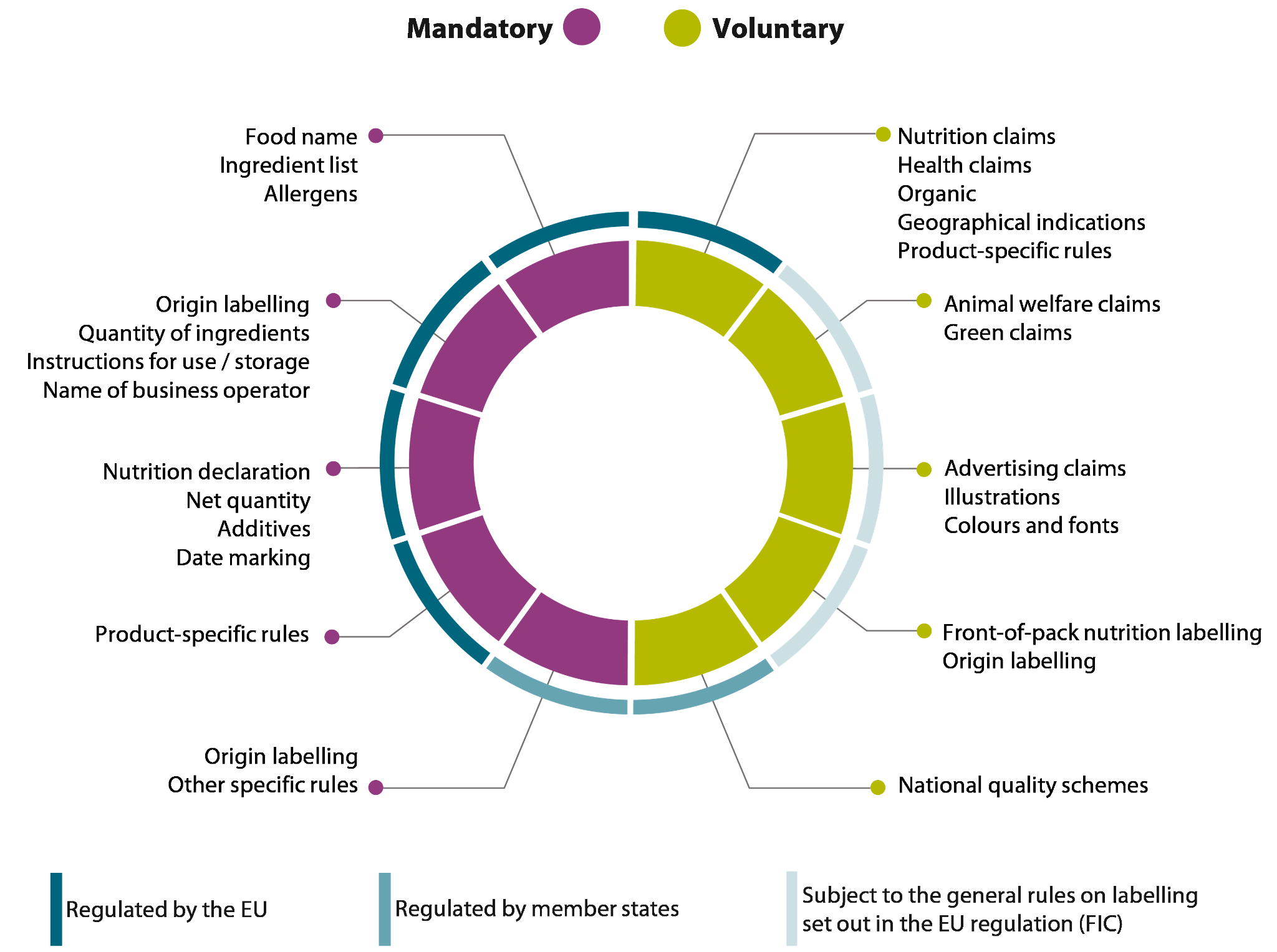
What information must food companies mandatorily include on the label?
Food sector companies know well that a product is defective even when the label doesn’t clearly show the information required by European law to protect consumer health.
A labeling defect can lead to a costly recall campaign, even before the product reaches supermarket shelves or consumers’ tables!
For convenience, we provide below a table that clearly shows all the information that must appear on the label.
What is the average cost of a recall campaign?
The average cost of a product recall campaign varies significantly based on the sector, the severity of the problem, and the territory from which the product is being recalled.
According to an analysis conducted by Allianz Global Corporate & Specialty (AGCS) on insurance recalls, the average cost of a “significant” recall is around 8 million euros.
With specific reference to the food sector, a survey conducted by the Grocery Manufacturers Association (GMA) and the Food Marketing Institute (FMI) in the United States estimated that the average direct cost for a food recall is about 10 million dollars (equivalent to about 9.5 million euros).
Beyond direct damages from disposal and recall, companies must absolutely not overlook indirect costs such as lost sales, business interruption, legal expenses, and particularly, damage to brand reputation.
Can we summarize these costs?
Below we indicate for simplicity the main expense items divided between direct, indirect, and reputational costs:
Direct costs:
Labor, shipping, handling, disposal of defective products, internal investigations, and notification expenses.
Indirect costs:
Legal expenses, regulatory penalties, potential class action lawsuits, temporary production interruptions, and equipment modifications.
Reputational costs:
Brand damage, loss of sales, and decreased consumer loyalty (a significant factor, with some studies suggesting that up to 68% of consumers would stop purchasing from a brand after a food safety incident).
When does cross-contamination of food products occur?
Cross-contamination occurs when contaminants transfer from one food product to another, or from unclean surfaces, equipment, or personnel to food.
The main sources include:
Non-sanitized vehicles/equipment: use of a vehicle not properly cleaned after transporting non-food items or a previously contaminated load.
Improper handling: poor personal hygiene, such as inadequate hand washing, by drivers, employees, or loading personnel.
Is it true that children are more exposed to physical harm from food contamination?
The answer is yes.
Children are particularly vulnerable to contaminants because they consume more food and beverages relative to their body weight compared to adults, have immature detoxification systems, and their vital organs are in critical stages of development. Health consequences can include: neurological developmental damage, cognitive defects, learning difficulties, attention deficit disorders (ADHD), physical malformations and birth defects, low birth weight, premature birth, and stillbirth; organ damage and diseases; hormonal disorders; acute illnesses and death.
That’s why companies must pay utmost attention.
Are company directors liable if a contaminated product is recalled?
Both in Italy and abroad, company directors can be held civilly and, in certain circumstances, criminally liable if a defective product is recalled.
The liability of directors does not automatically arise from the fact that a product has been recalled, but from the assessment of their actions and the fulfillment of their duties of diligence in business management.
To be clear, if the product recall is attributable to negligent decisions, insufficient control activities, or inadequate implementation of safety procedures required by current regulations, directors may be held personally liable for the damages suffered by the company: recall costs, economic losses, penalties.
In cases of particular severity, where the defective product has caused injuries, illnesses, or death, or if directors have deliberately placed dangerous products on the market in violation of specific food regulations, criminal offenses may arise that entail personal criminal liability.
Why is contamination liability insurance so important for the legal defense of company owners and directors?
The main advantage of this solution is that the policy immediately covers legal expenses, which can be very high, regardless of the outcome of any legal actions taken against the company or the director.
The policy ensures that directors and owners have access to qualified legal defense without having to use personal or company resources before even knowing the outcome of the trial.
So is the defective product policy alone not enough?
One thing is the possible harm to people caused by the presence of a foreign object in a jar of yogurt, another is finding the presence of salmonella in a batch of poultry ready for distribution: these are completely different events that can lead to equally different compensation claims and require separate insurance solutions.
They may seem like subtleties, but insurance companies, when faced with a compensation claim, are the first to carefully verify whether their insured is covered against these risks, and in the end, the rule of black and white applies: either we are insured or we are not (!).
It is precisely for this reason that we always suggest companies be followed by insurance consultants with experience in this sector: avoiding the risk of paying several million euros in recall campaigns is absolutely strategic to protect budgets from very high and unexpected expenses.
In conclusion: reducing risks is as important as insuring oneself.
For companies involved in processing and selling food, contamination often represents a dramatic event.
The immediate deployment of technical personnel to identify the cause of contamination along the production and cold chain and lawyers to defend against third-party damage claims can be a very significant financial commitment.
In the current information landscape, subject to rapid changes, a product recall can quickly compromise consumer trust, with significant consequences on the brand’s reputation and the company’s profitability.
This underscores the importance of implementing systems that place food safety first, in a context characterized by numerous dynamic challenges.
To ensure optimal effectiveness, it is essential to implement food safety and biosecurity measures that protect food systems from the introduction and spread of harmful organisms throughout the entire production cycle, including pathogens, parasites, and diseases.
Purchasing insurance against risks from food defects and contamination must always be accompanied by the daily use of risk reduction strategies that we will analyze in a future article.