
Last updated: September 2026
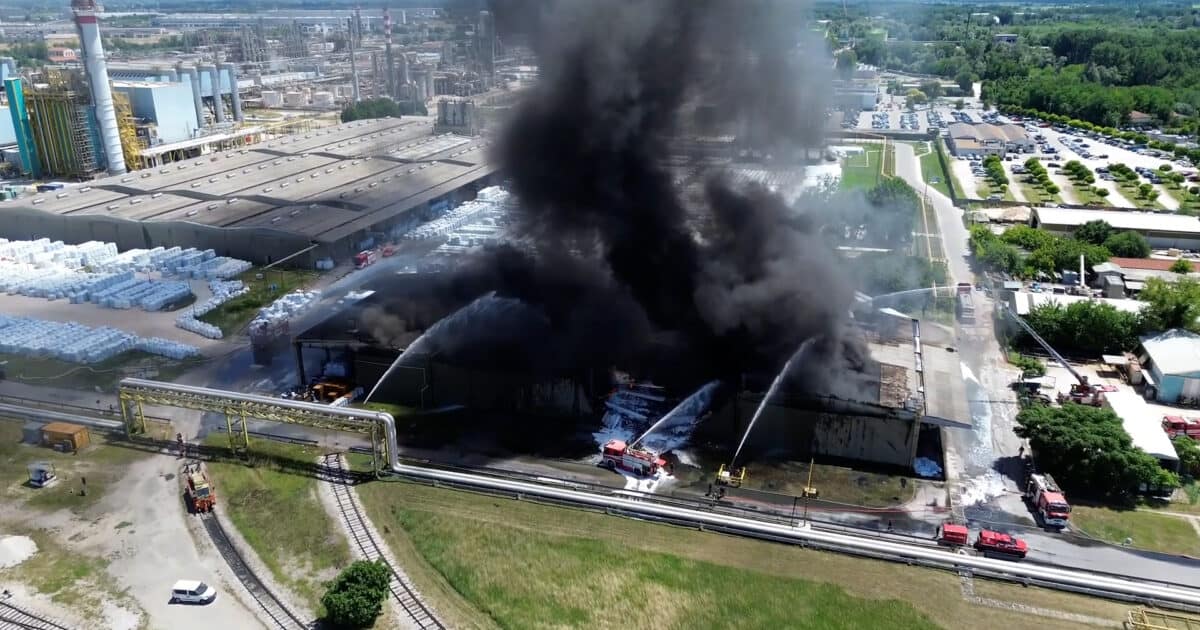
The increasingly frequent fires that destroy factories, offices and warehouses teach us that flames, if not brought under control in time, are unforgiving.
In the event of a devastating fire, employees are at risk of suffering serious burns. If, on top of that, shortcomings in health and safety at work are discovered, directors are liable to pay compensation for physical and biological harm.
Below, we address the key questions raised by managers and company directors regarding the very serious legal risks they face when one of their employees sustains serious burns at work, along with insurance solutions designed to protect their personal assets.
Statistically speaking, how many fires in Europe over the last five years have affected businesses, warehouses and non-residential buildings?
There are around 2 million fires a year in Europe, averaging 5,475 fires a day.
Of these, fires affecting businesses, warehouses, industrial premises and non-residential buildings account for around 10 per cent of the total, translating into an estimated figure of over 200,000 incidents a year across the continent.
Although 90 per cent of structural fires are concentrated in the residential sector, we must not overlook the fact that fires in commercial and industrial premises have the most devastating economic impact.
Fires in Europe cause material damage amounting to approximately 126 billion euros a year, equivalent to almost 1% of European GDP, and a large part of this figure is linked precisely to the destruction of business assets and supply chains.
How many people die as a result of fires breaking out in businesses, warehouses and non-residential buildings?
Statistically speaking, around 10 per cent of all fire-related deaths in Europe occur in businesses, warehouses, offices and other non-residential premises.
Given that there are a total of around 5,000 fire-related fatalities in Europe each year, the estimated number of deaths in workplaces and commercial buildings stands at around 500–1,000 deaths per year.
Do managers risk having to pay out of their own pockets for the physical and biological injuries sustained by an employee who has suffered burns?
When an employee is injured at work, individual directors risk facing a lengthy and costly legal battle to prove in court that they were not responsible for the incident, in addition to having to pay hefty fines and penalties imposed by the supervisory and regulatory authorities.
Furthermore, should our employee lose their life as a result of the fire, we run the risk of facing criminal proceedings.
I would, however, like to emphasise that the company’s liability for fire-related accidents at work is by no means a foregone conclusion, given that there are court rulings, as we shall see below, which assert the exact opposite.
Where the worker’s conduct is deliberate and arbitrary – that is, illogical and unrelated to production objectives – liability for the accident cannot be attributed to the employer but to the employee.
This does not alter the fact that, from the very first investigations following the incident, the individual directors implicated must advance substantial sums of money to their lawyers to prepare their defence.
The risk of having to bear legal costs personally in proceedings for breaches of workplace safety regulations applies not only to statutory directors but also to those executives, middle managers, professional staff and country managers who, although not legally classified as directors, are nonetheless vested with decision-making powers in the field of safety and prevention and are therefore liable under the law.
The law establishing the offence of breaching workplace safety legislation against executives refers, in fact, to the actual performance of their respective duties. Liability is therefore linked to the actual performance of the role.
However, we can obtain reimbursement of legal and court costs thanks to specific insurance cover designed to protect the assets of individual directors and executives, as we shall see in the concluding section of this article.
When do company directors and owners risk having to pay compensation to an employee out of their own pockets?
Below are some extracts from key court rulings that attribute liability in various ways either to the employer or to the individual employee, accompanied by the judge’s reasoning.
In a nutshell, if one of our workers is injured at work, liability may lie either with the company or with the worker themselves.
In the first instance, if health and safety at work regulations have not been complied with, the business owner, managers and directors may be held personally liable in court for the worker’s injury or death.
In the second instance, the employer is exempt from liability when it is the employee who, as a result of ‘abnormal’ behaviour, has exposed themselves, at their own risk, to accidents and injuries at work.
With regard to physical injuries caused by a fire (which has broken out in production areas, the canteen or the warehouse, where there is a high fire load), if an employee were to suffer severe burns, the owner and the directors risk having to appear in court to defend themselves against a claim for damages.
Should the authorities find a breach of health and safety at work regulations, civil and criminal liability falls squarely on the manager, with the risk that the individual director may have to pay, out of their own personal assets, for all physical and biological harm suffered by the worker.
With regard to the risks faced by the employer, I would like to emphasise that there are numerous court rulings holding the company itself liable (in both civil and criminal proceedings) for accidents involving its employees.
For the sake of brevity, I have listed three such cases below: the courts have attributed liability for employees’ accidents to the owners of the companies where the accident occurred.
In Judgment No. 32286 of 2006, the Court of Cassation ruled that an employer may be liable for manslaughter if the employee did not have access to the necessary safety equipment to prevent accidents in the workplace.
The Court of Cassation, in its judgement No. 50000 of 6 November 2018, stated that fault may consist of negligence, imprudence and incompetence, aggravated by a breach of health and safety at work regulations, where there is a lack of adequate accident-prevention measures to prevent the risk of burns to workers through the provision of suitable personal protective equipment.
Judgment No. 1218 of 2020 established that, even where the worker has behaved imprudently, the employer cannot be exempted from the offence of manslaughter if they have neglected safety procedures by failing to comply with accident prevention regulations.
When is the worker liable?
We must not, under any circumstances, overlook the cases in which the courts have held the worker liable for the accident.
In the Supreme Court judgement No. 8988 of 2020, the victim of an accident at work was held solely responsible for the incident due to ‘abnormal, inexplicable and excessive behaviour in relation to the work process and the instructions received’.
Where the employee’s conduct is deliberate and arbitrary – that is to say, illogical and unrelated to the purposes of production, driven by purely personal impulses, and abnormal in the context of carrying out their work – liability for the accident may be attributed to the employee.
In its judgement No. 6505 of 27 January 2021, the Criminal Division of the Court of Cassation, Section IV, ruled on the matter of workplace accidents in the context of the worker’s reckless conduct
The judges held that the worker’s behaviour may be deemed abnormal – and therefore such as to break the causal link – when it consists of conduct that is radically and fundamentally at odds with the conceivable, and therefore foreseeable, choices – even if imprudent – that the worker might make whilst carrying out their work.
Who pays the legal defence costs?
From the judgements we have just mentioned, it is clear to everyone that liability for a serious fire-related accident at work does not always lie with the company.
If we believe that our employee exposed themselves to the risk of accidents at their own risk and peril, we must prove this in court by instructing lawyers specialising in employment law from the very outset of the proceedings.
Given that it is always a judge who determines where liability lies – whether with the employee or the employer – we strongly advise business owners to take out specific insurance cover to reimburse those legal costs which would otherwise be borne entirely by the individual directors, such as:
- cover for legal costs in the event of a claim for compensation against an individual
- investigation costs, legal representation costs, and professional fees incurred in the context of a formal investigation by an administrative body
- legal costs and professional fees incurred in opposing interim measures
- costs for restoring reputation
- coverage of emergency legal costs, as well as travel and accommodation expenses incurred by a family member to attend court.
Why is Directors and Officers’ insurance so highly recommended?
It may seem all too obvious, but when a fire breaks out at a business, insurance cover for the premises and third-party liability is important but often not enough.
An insurance policy against fire damage is essential for compensating for physical damage to our own property (the building, stock in the warehouse, machinery, etc.).
Third-party liability cover is equally important to protect us from a claim for compensation from those who have suffered financial loss as a result of a fire in our building (in the example given above, the owners of the bicycles that were completely destroyed in the warehouse in Vicenza; or consider the case of a third-party business adjacent to ours that was damaged by flames spreading from our building…).
In addition to these two policies, we recommend taking out directors’ and officers’ liability insurance.
As we have seen in the court rulings above, the court may hold the company and its managers liable for errors, omissions and/or breaches of their obligations regarding health and safety at work.
We therefore recommend checking very carefully whether we are covered by a sufficiently high limit to cover the legal and court costs incurred by individual executives and directors.
It may seem all too obvious, but when a fire breaks out at a business, insurance cover for the premises and third-party liability is important but often not enough.
An insurance policy against fire damage is essential for compensating for physical damage to our own property (the building, stock in the warehouse, machinery, etc.).
Third-party liability cover is equally important to protect us from a claim for compensation from those who have suffered financial loss as a result of a fire in our building (in the example given above, the owners of the bicycles that were completely destroyed in the warehouse in Vicenza; or consider the case of a third-party business adjacent to ours that was damaged by flames spreading from our building…).
In addition to these two policies, we recommend taking out directors’ and officers’ liability insurance.
As we have seen in the court rulings above, the court may hold the company and its managers liable for errors, omissions and/or breaches of their obligations regarding health and safety at work.
We therefore recommend checking very carefully whether we are covered by a sufficiently high limit to cover the legal and court costs incurred by individual executives and directors.