

As a lover of the sea and holder of a boat license, I can confirm how important it is to prevent and reduce the main risks of navigation that can endanger the health and safety of passengers, such as sinking, running aground, collisions, and fatal falls into the sea due to alcohol consumption on board.
Below, we offer an overview of these events that must be avoided at all costs.
Further practical insights for skippers and owners of medium to large boats on measures to prevent and reduce the main risks will follow.
Ample space will be devoted to international insurance solutions to protect the boat, passengers, and the personal assets of the captain and owner.
What are the most frequent devastating risks faced by a medium to large boat?
The most serious risks for medium and large yachts and sailboats are sinking, running aground, and collisions, not to mention the consequences in terms of compensation that the skipper and boat owner face towards the relatives of those who have been injured or lost their lives on the boat.
We are therefore faced with risks that do not only concern the boat itself.
The risk of compensating for damage to property and persons following a collision due to a wrong maneuver attributable to our skipper can be very costly.
What are the main causes of fire and explosion?
The increasing use of electronic equipment, tenders, and battery-powered systems has increased the risk of overheating, which can lead to fire.
Fuel leaks, electrical failures, and overloaded generators in enclosed, oily spaces often cause uncontrollable and rapidly spreading fires. The risk increases when a fire breaks out inside an engine room, which is difficult to reach.
Owners of expensive sailboats or luxury yachts are warned: a fire that spreads beyond the initial compartment can destroy the vessel in a matter of minutes.
Does lightning also pose a serious threat to medium-sized and large boats?
Absolutely, and the case of a Sunreef 70 yacht that caught fire in the Dominican Republic is one of the most emblematic and recent examples of the devastating effects of lightning on a modern luxury boat.
In August 2025, a 21-meter sailing catamaran worth $3 million sank due to the devastating effects of lightning: the huge shock caused a fire which, fueled by composite materials made of resins and carbon fiber, quickly spread throughout the boat.
Despite the intervention of the fire department, the vessel was completely destroyed in a few hours; the carbon mast collapsed and the hull was left a charred wreck.
What does this serious accident teach us?
Every year, thousands of lightning strikes occur at sea, and it is mainly sailboats that pay the price, as size is the most important factor: the larger the boat and the taller the mast, the more it acts as a “target” for electrical discharges.
This is why lightning often strikes boats with tall masts, making it necessary to replace the entire electrical system and sometimes the mast itself.
When lightning strikes a boat, the energy discharged in millions of volts seeks the quickest route to the water, often damaging the mast, destroying the on-board electronics (GPS, radar, radio) and risking causing fires or holes in the hull.
Even if the boat is on land, the impact can cause short circuits and serious structural damage. Since many modern boats use carbon fiber masts or reinforcements, the resistance to the passage of millions of volts generates enough heat to cause the resin that holds the fibers together to explode.
Which geographical areas of the world are most affected by lightning and what is the seasonal risk?
Florida is certainly one of the areas most at risk, with an estimated 20% of sailboats moored in Florida being struck annually.
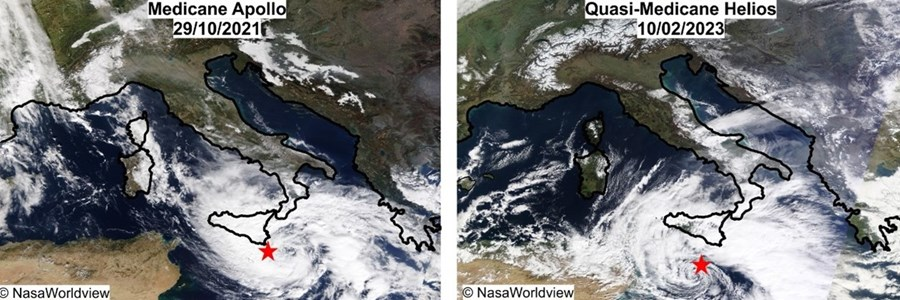
Lightning damage is also on the rise in the Mediterranean: insurers record 10-12% of total boat accident cases, and satellite images of Cyclone Helios speak for themselves.
Developing in the Mediterranean between February 9 and 11, 2023, it was an intense low-pressure system. Similar to a tropical cyclone, it hit southeastern Sicily and Malta hard with wind gusts of up to 90-100 km/h and intense storms before heading towards the Libyan coast.
What risks does alcohol consumption on board pose for skippers, passengers, and boaters?
Alcohol is considered the main contributing factor in fatal boating accidents, responsible for approximately 20% of deaths in recreational boating.
It is a risk that is underestimated not only by skippers but also by those who are on a boat to enjoy sports, unique moments, and spectacular views: the sun, the wind, and the carefree moments typical of those who experience the sea on a boat amplify the sensory impairment caused by alcohol, leading to loss of balance, reduced reflexes, and dangerous falls into the sea, which can be fatal, especially when intoxicated and without a life jacket.
With specific reference to yachts, considering that we are talking about boats where the hull is higher, for obvious reasons, than small boats, the risk of drowning due to a fall into the open sea from a considerable height is a tragedy that must be prevented and averted at all costs.
If a passenger dies as a result of falling into the sea, what financial risks does the skipper or owner of a yacht face?
In the event of a person’s death as a result of falling into the sea, the skipper and owner of the boat face very serious financial risks, in addition to criminal ones.
Civil liability rests jointly and severally on both, as the captain is responsible for navigation and safety, while the owner is responsible for the maintenance and equipment of the boat.
Returning to the example of alcohol consumption mentioned above, if witnesses confirm that the skipper allowed wine or beer bottles to be brought on board and consumed, and if blood tests on the passengers reveal the presence of these beverages above the legal limits, their position could be seriously aggravated.
Consider the risks of compensation that both parties may face following the death by drowning of an important company executive or the scion of a well-known family of entrepreneurs following a fall into the sea due to alcohol consumption on board.
European laws provide for very severe penalties for those who operate a boat while intoxicated (with blood alcohol limits similar to those for motor vehicles), which may include the seizure of the boat and the suspension of the boating license.
If a medium-to-large boat sinks, who is responsible for paying the very expensive costs of recovering the wreck?
In the event of sinking, by law, the costs of recovering the boat are borne by the owner/operator, who is responsible for removing the wreck to prevent pollution and hazards to navigation.
The costs of recovering a medium-large yacht or sailboat vary greatly: they range from a few tens of thousands of euros for simple operations to tens of millions of euros for complex superyacht operations.
The costs can be covered by a hull insurance policy, while compulsory third-party liability insurance alone is often not enough.
Given that this is a very complex subject, we will be taking a closer look at the legal and insurance aspects in the coming weeks.
What advice can we give to skippers and owners of medium to large yachts and sailboats?
Above, we have outlined the most serious risks to both our boat and our wallet.
Direct damage to the boat is one thing, but ending up in court and defending yourself against accusations of negligence, incompetence, and poor boat handling is another. Our boat could be seriously damaged by lightning and sink, or passengers could be injured in a collision with another vessel.
The insurance market offers a wide range of coverage to protect boats and passengers.
However, with so many offers available, it is always best to seek the advice of insurance consultants who are experts in preventing and reducing navigation risks.
If there is an accident, they are the ones who help us obtain compensation for damages, and they are also the ones who assist us before taking out the policy, providing us with the general prevention guidelines that are essential to ensure our safety and peace of mind and that of our passengers.
The sea is a true passion not only for many sports enthusiasts but also for the author of this article, who holds a boating license and is equally passionate about the world of sailing and motorboats.